The EMotorad T-Rex Pro made the steepest part of our test route feel much easier than it would on a conventional mountain bike. That is the reason to consider it. With assistance switched off, though, it was heavy going. We rode it on roads, through woodland and up a demanding hill to find out who it really suits.
Disclosure: EMotorad gifted our test bike to the E-Bike Geek team. There was no payment, required wording or brand approval. This review reports one 11 km ride, not long-term reliability or measured full-battery range.
In This Article
- Our verdict after the ride
- How we tested the EMotorad T-Rex Pro
- Assembly, first impressions and fit
- Motor assistance on roads, hills and woodland paths
- Handling, gears and brakes
- Battery, charging and what we can say about range
- Display, lights and practical equipment
- The compromises and who should buy it
- Frequently Asked Questions
Our verdict after the ride
For mixed road and light woodland riding, the T-Rex Pro’s strongest feature is how much help its five pedal-assist levels give on a climb. Our 85 kg rider could start a steep hill in the lowest assist level. As the gradient rose, changing down to third gear and selecting level three or four kept the bike moving without the climb becoming a slog. It also handled the roots and narrower paths on our woodland section confidently.
Our dry-weather ride cannot establish how it behaves on wet roots or long descents. The rack, mudguards, lighting and indicators make it a more rounded road-and-path bike than its mountain-bike label suggests. We would shortlist it for hilly leisure rides and ordinary journeys, provided the frame fits.
What we liked: strong help on hills, reassuring brakes, comfortable saddle, useful lights and responsive support.
What we would change: clearer display instructions, better mudguard protection in transit and a less odd-sounding horn.
How we tested the EMotorad T-Rex Pro
One team member, 185 cm tall and weighing 85 kg, rode 11 km in cloudy, dry weather. The route included flat roads, a busy town centre, rooted woodland paths and a steepening hill. We tried all five assistance levels, changed gears on the climb, and checked the brakes, lights, indicators, walk mode and controls.
We did not empty the battery, weigh the bike, ride through rain or attempt technical descents. We therefore cannot promise a range, judge durability or rate the suspension for hard trail use. Manufacturer specifications and our observations are kept separate throughout this EMotorad T-Rex Pro review.
The current EMotorad UK product page illustrates a blue bike and lists a 250 W rear-hub motor, a 468 Wh battery, an 18-inch aluminium frame, a 100 mm front fork, hydraulic disc brakes and a seven-speed Shimano Altus derailleur. Its own range figure varies between 43 and 45 miles on that page. Neither number is a result from our 11 km test.
Assembly, first impressions and fit
An hour to set up, with one shipping snag
Assembly took about an hour and was manageable without specialist equipment; several supplied tools were useful. The box also contained a quick-start guide. Allow time to check the brakes, wheels, fasteners and connections before riding rather than treating “part-assembled” as “ready to go”.
The rear mudguard had been squashed in transit and was out of line. Straightening it took roughly 20 minutes and was not covered by the instructions. We found no other fault or rattle, but check the guard and wheel clearance before your first ride.
Fit for a taller rider
At 185 cm, our rider found the frame slightly smaller-feeling than their usual mountain bike, though comfortable to pedal. EMotorad’s UK shop suggests 167–182 cm for the T-Rex Pro. If you are at the top of that range or taller, take a test ride; reach and standover matter more than the frame-size label.
The saddle stayed comfortable throughout. With assistance off, pedalling felt much harder than on a regular mountain bike. Our team was supplied a 21 kg specification for this review bike, but we did not weigh it; the pedal-off heaviness is what we actually experienced.
Motor assistance on roads, hills and woodland paths
Flat roads and the five assist levels
The move from no assistance to level one was immediately noticeable. On flat tarmac, our rider reached about 20 km/h with light pedalling. In level five, the display reached 25 km/h while the rider pedalled, and acceleration felt easier again.
Our rider felt the motor still helping at that displayed 25 km/h. That is around the UK limit for motor assistance on an ordinary electrically assisted pedal cycle. We did not use an independent speed meter or measure precisely where assistance stopped. You can still pedal or coast faster once the motor has cut out; our observation is a ride impression, not a certification test.
Climbing and woodland riding
The hill was where this bike made its case. The lower part felt easy at level one. When it steepened, the rider shifted down to third gear and raised assistance to level three or four. The climb remained manageable. We did not measure the gradient, so this is an account of one hill, not a promise for every climb.
In the woods, it stayed composed over roots and along narrow paths. Assistance made it less tiring to rebuild speed after slowing. We did not test mud, rocks or technical descents. For demanding trails, compare purpose-built e-MTBs.
Handling, gears and brakes
The T-Rex Pro handled well on our roads and woodland paths. We heard no rattle and found no awkward control behaviour during the 11 km ride. That is a first impression, not a durability finding.
All seven gears worked well. We did not miss the wider gear range of our rider’s conventional mountain bike while using assistance, and third gear paired well with higher assistance on the hill. Riders planning long unassisted stretches should try the gearing for themselves.
The hydraulic disc brakes stopped it promptly without feeling grabby. The tyres and fork coped with the roots we encountered. We did not assess wet braking, prolonged descending or wear.
Battery, charging and what we can say about range
After unboxing, a full charge took approximately five hours. Charging and attaching the battery were simple. EMotorad specifies a 36 V, 468 Wh battery and a five-to-seven-hour charging window, matching our experience. We did not measure electricity use or battery ageing.
After 11 km, including a steep climb and several assist levels, the five-segment display had lost one bar. Bars are coarse indicators, not equal fifths of usable range. Multiplying 11 km by five would invent a range result we did not achieve.
Display, lights and practical equipment
Controls and walk assist
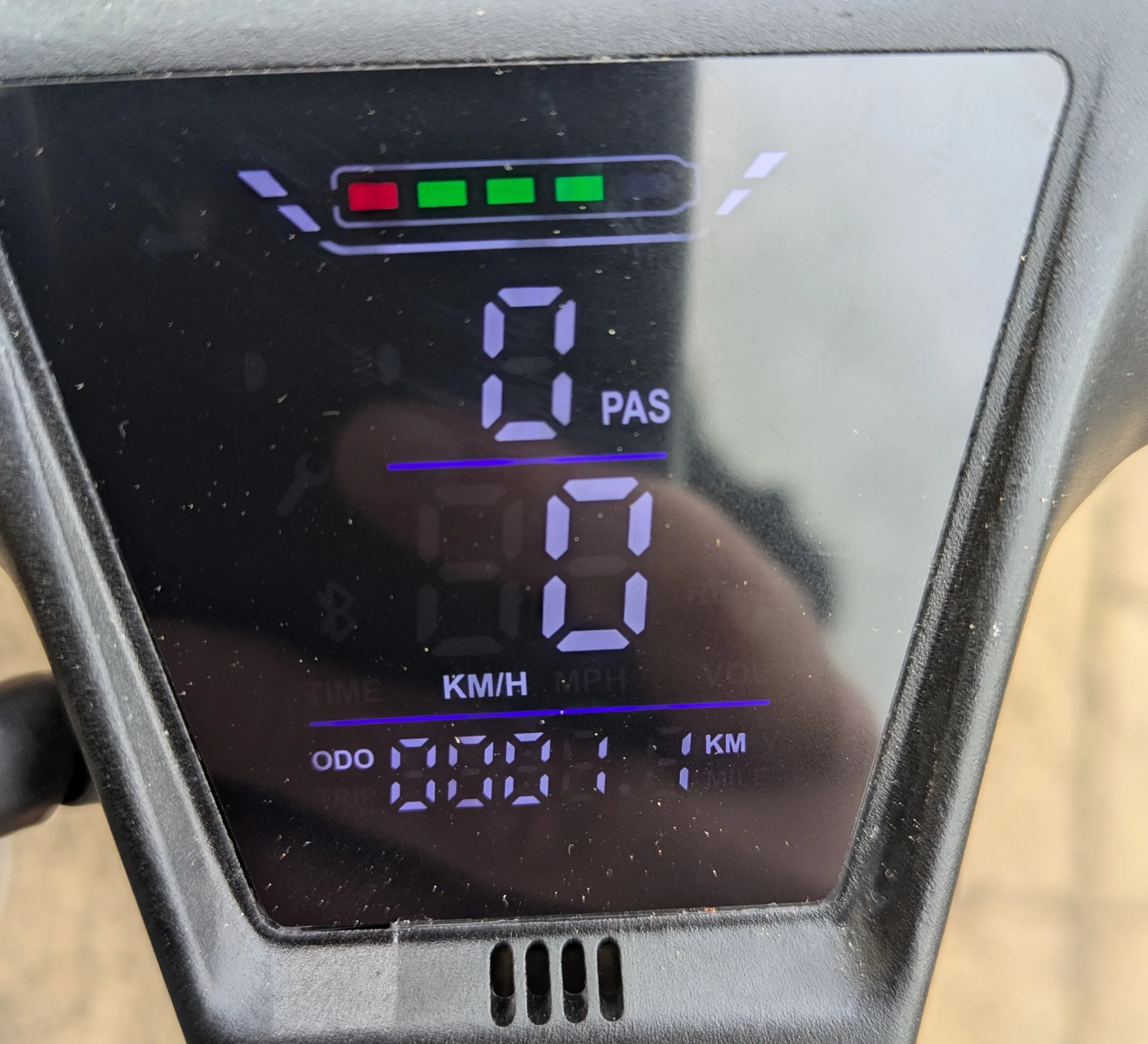
The display shows assist level, speed, battery bars and ride data. Changing its initial km/h setting to mph was fiddly. EMotorad support replied quickly and helped, but the instructions should explain the process without a support call.
Walk assist moved our test bike at about 5 km/h without pedalling, useful when guiding it rather than riding.
Lighting, signals and carrying kit
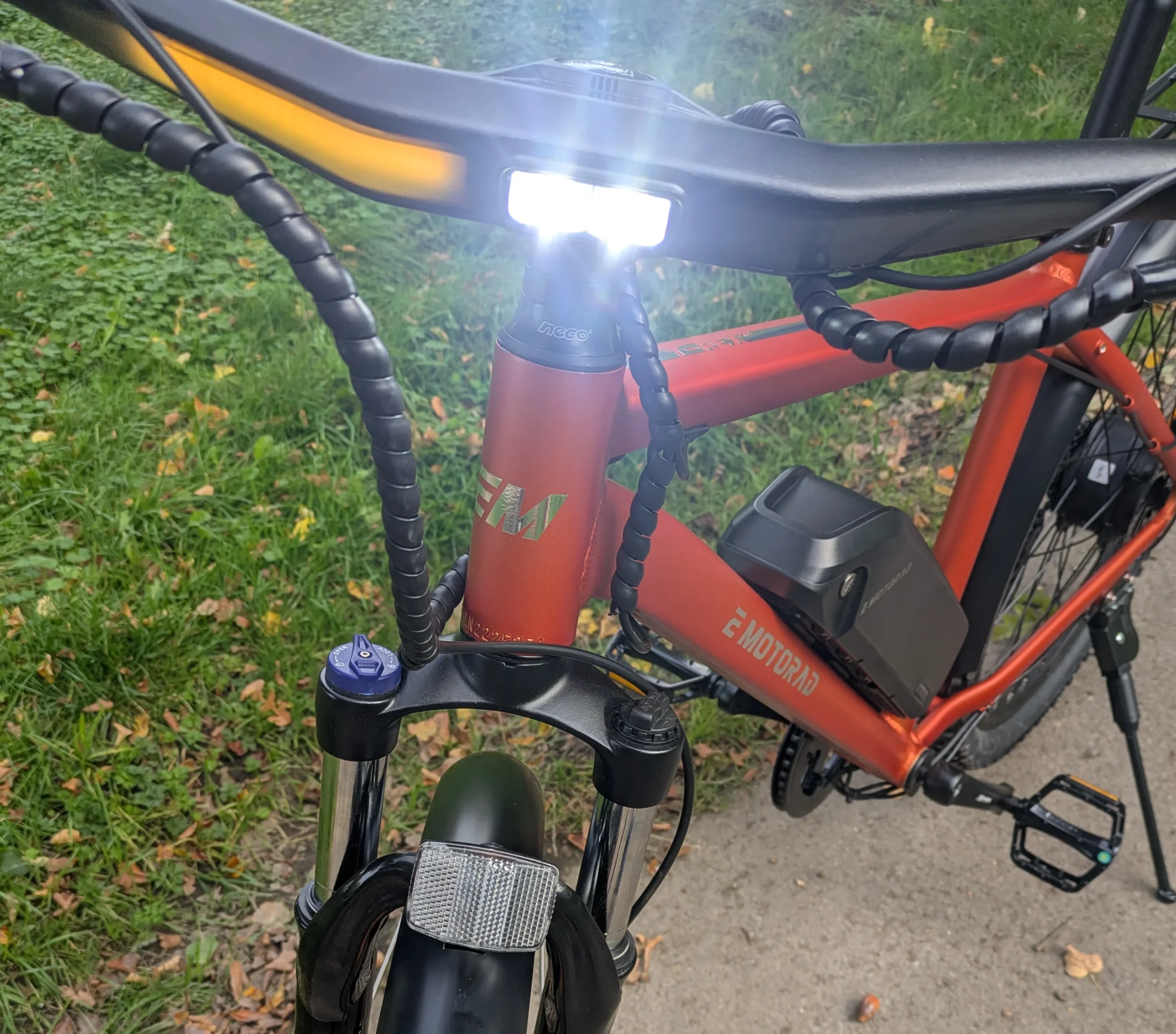
The integrated front light looked bright in cloudy conditions; the rear light and indicators were easy to use. We especially liked the indicators in a busy town centre, though we would not rely on them instead of checking and signalling clearly to others. We did not test night visibility or measure beam distance.
The horn worked, but sounded odd on a bicycle; we would prefer a bell. The rack and mudguards add practicality, even if we would not choose a rack for a mainly woodland bike. It did not get in our way.
The compromises and who should buy it
The T-Rex Pro took the sting out of a steep climb, made road riding easy at low assist and felt controlled over modest woodland obstacles. Brakes, gears, saddle, lights and support all impressed us. We would consider buying one with our own money for a similar mix of hilly leisure rides and everyday journeys.
The frame felt a little compact to our 185 cm rider; setup included a mudguard repair; display instructions were thin; and unassisted pedalling was hard. A short test ride also cannot settle longer-term reliability or exactly where the assistance cuts out, so those remain sensible checks for a buyer.
Ownership questions before ordering
Our customer-support experience was positive: the team replied quickly when we needed help with the mph setting. One helpful exchange does not tell us how a warranty claim or replacement battery order would go. If buying online, ask how a local repair is arranged and whether a compatible battery can be supplied later. Also check the bike’s actual delivered weight if you will have to lift it onto a rack, up steps or into storage; we did not lift ours in those conditions.
Check EMotorad’s current price and the terms applying to your order. The product page says five years for the frame, while its UK warranty policy says lifetime for aluminium frames. The policy also says registration within 14 days adds a year to motor and battery cover. Get the terms applicable to your purchase in writing rather than assuming the more generous figure automatically applies.
For light trails and hilly everyday riding, it is worth a test ride. For hard descents or a lively ride with power off, look elsewhere. The sensible comparison is not with a high-end downhill e-MTB but with other practical hardtails around the same budget. If you are weighing up alternatives, see our best e-bikes under £1,500 guide.
Frequently Asked Questions
How far did it go on a charge in your test? We rode 11 km after charging fully and the display lost one of its five battery bars. We did not ride to empty, so this is not a measured maximum range.
How was the T-Rex Pro on hills? Our rider began a steep climb in assist level one, then shifted to third gear and increased assistance to level three or four as the gradient rose. It felt much easier than tackling the same climb unassisted.
Will the frame fit a tall rider? At 185 cm, our rider found it a little smaller-feeling than their usual mountain bike but still comfortable to pedal on the test ride. EMotorad’s suggested height range tops out at 182 cm; taller buyers should try the bike in person.
Can you ride it on UK roads? EMotorad lists a 250 W motor and 15.5 mph assisted speed, and our rider felt assistance at a displayed 25 km/h. That does not establish the exact cut-off point. Check the bike’s required markings and UK EAPC rules before riding; we did not perform an instrumented compliance test.