The best e-bike under £1,500 for you depends on where you ride and where you store it. The EMotorad T-Rex Pro is the only bike here our team has ridden: on one 11 km route it made a steep climb and woodland paths feel easier while remaining comfortable on the road. A full-size HITWAY, a folding ENGWE and a step-through FLYRUN answer different needs. This is a short, practical comparison, not a claim that we have road-tested every model.
Disclosure: EMotorad gifted us the T-Rex Pro; it did not pay for or approve our verdict. We rode that bike for 11 km. We have not ridden the three Amazon bikes, so our comments about them cover their stated features and practical trade-offs rather than ride performance. Some buying links may earn us a commission at no extra cost to you.
Our top e-bikes under £1,500
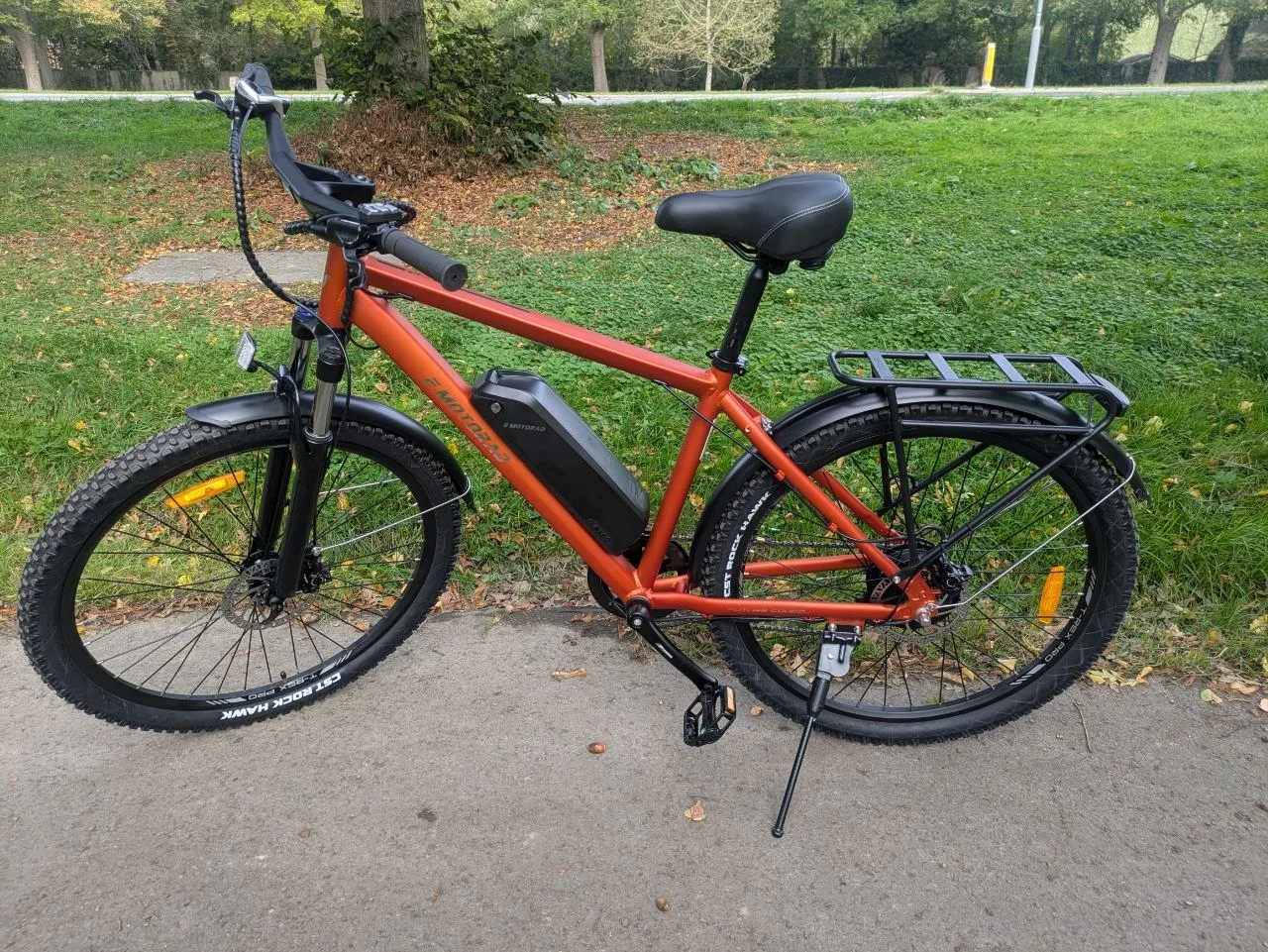
EMotorad T-Rex Pro
Our first-hand-tested hill and trail pick
Easy climbing and comfortable mixed-surface riding on our 11 km test; heavy with assistance off.

HITWAY BK7S
Full-size commuter-style choice
A conventional riding shape and removable battery; confirm the wheel-size variant before ordering.

ENGWE EP-2 Boost
Folding fat-tyre choice
Foldable frame and wide tyres, but the manufacturer lists a substantial 30 kg bike weight.

FLYRUN 20-inch step-through
Step-through utility alternative
Low-entry frame, basket and rack; check the seller and after-sales terms carefully.
Contents
- Comparison at a glance
- Our four e-bike picks in detail
- Which type of e-bike suits you?
- Battery, range and hills
- UK road rules and buying checks
- Our verdict
- Frequently asked questions
Comparison at a glance
These bikes do not all solve the same problem. A folding hinge does not make a heavy bike easy to carry, and a full-size frame will not fit a narrow cupboard. Treat the manufacturer’s maximum-range figures as laboratory-style upper bounds, not a commuting promise.
| Bike | Good fit for | Defining feature | Trade-off |
|---|---|---|---|
| EMotorad T-Rex Pro | Hilly mixed-surface rides | Comfortable assisted climbing in our short ride | Heavy to pedal without assistance; fit may feel compact to taller riders |
| HITWAY BK7S | Full-size road and path trips | Removable battery and conventional bike shape | Check the exact wheel-size and equipment option |
| ENGWE EP-2 Boost | Folding storage with wide tyres | 20-inch fat tyres and folding frame | Manufacturer lists a 30 kg bike weight |
| FLYRUN step-through | Easy mounting and utility use | Low-entry frame with basket and rack | Limited review history; confirm seller support |
Our four e-bike picks in detail
1. EMotorad T-Rex Pro: the one we rode
The T-Rex Pro is the first-hand choice in this guide. One team member, 185 cm tall and 85 kg, rode it for 11 km on dry roads, through woods and up a steep hill. Assistance at level one took much of the weight out of flat-road riding, while a lower gear and levels three or four kept the bike moving as the gradient rose. The saddle was comfortable for the whole route and the brakes stopped promptly without feeling abrupt. The display, lights and indicators were useful; the horn sounded less natural than a bicycle bell.
We also found limits. With assistance off it felt markedly heavier than an ordinary mountain bike. The frame felt a little smaller than our rider’s usual bike, though not awkward. Assembly took roughly an hour, and a rear mudguard squashed in transit needed another 20 minutes of adjustment. After fully charging the battery, the 11 km hilly test used one of five display bars; that is not a measured full-charge range. Read our full T-Rex Pro ride review for the setup, controls and route in detail.
EMotorad lists a 250 W rear-hub motor, 468 Wh battery, hydraulic disc brakes and a seven-speed Shimano Altus derailleur. Its listed 21 kg weight is a specification, not our measurement. This looks most sensible for someone who wants help on hills and modest woodland paths, not a bike they intend to ride motor-off or carry up many stairs.
- Choose it if: hilly leisure rides and mixed surfaces match your usual route.
- Think twice if: you need a light, unassisted-feeling bike or a large-feeling frame.
- Evidence: one 11 km first-hand ride, not a long-term or full-range test.
2. HITWAY BK7S: a full-size riding shape
The BK7S is the more conventional bicycle-shaped alternative. The linked version lists a 250 W motor and a 36 V 12.8 Ah removable battery. A removable pack is useful if your bike is stored somewhere without a socket, although carrying it indoors and charging it safely still needs planning. The upright, full-size format is easier to understand for someone coming from a standard hybrid or mountain bike than the ENGWE’s small, wide-tyred folding layout.
Pay particular attention to the selected variation. BK7S options include 27.5- and 29-inch wheels, and HITWAY distinguishes its Pro and Plus versions. Do not assume the brakes, gears or tyres in a picture of one size are included with the other. Check the selected wheel size, frame fit and written specification before buying. We have not ridden this bike, so we cannot judge the assistance feel, braking or real-world range against the T-Rex Pro.
A full-size bike takes more room than a folded one, but a folding bike is not automatically better for a home with stairs. The riding position and easy access to the battery may matter more to a regular commuter than a hinge they seldom use.
- Choose it if: you want a familiar full-size riding position and removable battery.
- Think twice if: storage is tight or you cannot confirm which BK7S variation is selected.
- Check before checkout: wheel size, brake type, included accessories and seller support.
3. ENGWE EP-2 Boost: folding, but not light
The EP-2 Boost combines a folding frame with 20 × 4-inch tyres. ENGWE lists a 250 W motor, 48 V 13 Ah removable battery, seven gears, mechanical disc brakes and assistance limited to 25 km/h on its UK version. The wide tyres and compact wheel diameter distinguish it from the HITWAY’s conventional shape. The fold may help it fit a storage space or a vehicle, but measure the folded dimensions before buying: it is still a substantial bike.
The manufacturer lists the bike at 30 kg. That figure is why we would not choose it for daily lifting up stairs or onto a train simply because it folds. Its Boost control is another reason to confirm that the exact UK variant and settings match UK electrically assisted pedal-cycle rules. We have not ridden this model, so the manufacturer’s maximum range and climbing figures are not our results.
For a regular folding commute, compare the folded weight, hinge security and station rules as well as the battery. Our folding e-bike guide puts those trade-offs in context.
- Choose it if: a foldable fat-tyre bike suits your storage and riding mix.
- Think twice if: you must lift the bike regularly.
- Main compromise: storage flexibility without lightweight portability.
4. FLYRUN step-through: easier mounting, more seller checks
This 20-inch step-through offers a lower-entry frame, a front basket and a rear rack. That layout could suit shopping and shorter everyday journeys for a rider who finds a high top tube inconvenient. The seller describes a 250 W, 25 km/h pedal-assist setup and a removable 48 V 13 Ah battery. Those are specifications, not results from an E-Bike Geek ride.
The case for this model is accessibility and carrying convenience, not a proven performance lead. It has a smaller review history than the other Amazon picks, and long-term parts and service support are less clear. Check the seller identity, battery replacement path, warranty handling and your local service options before choosing it over a better-established step-through. The rack and basket also have limits; check their stated load ratings before carrying anything heavy.
Do not mistake step-through for a guarantee of fit. Saddle height, reach, frame geometry and the weight of the complete bike all still matter. If those are awkward, an easier mount alone will not make the ride comfortable.
- Choose it if: a low-entry frame and everyday carrying points matter most.
- Think twice if: you want a longer-established model and local support evidence.
- Check before checkout: seller, exact specification and support for the battery.
Which type of e-bike suits you?
Start with the journey, not the motor number
Ride mostly on roads and maintained paths? A conventional full-size bike such as the HITWAY is a natural starting point. If steep hills or woodland paths dominate, the T-Rex Pro is the one on which we can report an actual ride. For short journeys with shopping, a step-through frame and carrying points may be more useful than trail styling. If your storage is short but you do not need to lift the bike, the ENGWE fold can be useful. A true carry-on folding commute is a different requirement.
Check fit and storage before ordering
Look up the manufacturer’s recommended rider-height range, then check reach, standover, saddle adjustment and the distance between storage space and charging socket. A nominal wheel size is not a frame-size guarantee. Where possible, sit on a bike with similar geometry or arrange a test ride. Do not overlook the weight of the complete bike with its battery, particularly if there are steps between the bike and your front door.
If the upper limit of this guide is more than you need to spend, our lower-budget e-bike guide covers a different set of compromises. Do not pay extra for a specification you will not use; spend first on a bike that fits and can be serviced.
Battery, range and hills
Battery capacity, commonly stated in watt-hours, helps compare energy storage more fairly than an isolated amp-hour number. It still does not tell you how far you will ride. Rider weight, tyre pressure, temperature, hills, wind, stop-start traffic and assist setting all change consumption. The T-Rex Pro’s one-bar change after our 11 km route cannot be multiplied into a full-range claim, because display bars are not a calibrated fuel gauge.
For a demanding commute, plan with a margin and choose a battery you can conveniently charge. Ask whether a replacement pack is sold for the exact model and whether the charger and connector are proprietary. Our e-bike battery guide explains capacity, care and charging in more detail. A removable battery can simplify charging, but it does not make an unsupported bike a good purchase.
A motor’s nominal 250 W label does not tell you how natural its assistance feels on a climb. Gearing, sensor behaviour, torque delivery and the rider’s pedalling matter. On the T-Rex Pro our rider shifted down and increased assistance as the slope rose; we cannot extend that observation to the other three models. If your daily route includes a severe hill, test the actual bike or seek credible hill-ride evidence for that exact variant.
UK road rules and buying checks
For ordinary UK-road use as an electrically assisted pedal cycle, the motor’s continuous rated power must not exceed 250 W and it must stop propelling the bike above 25 km/h. Check the motor plate and supplied UK specification for the exact bike you buy. A seller’s “UK legal” phrase alone is not proof. The government’s e-bike rules explain the requirements; our UK e-bike laws guide covers practical riding questions.
- Confirm the exact variant: wheel size, brakes, controls and battery may change under one model name.
- Check who supports it: ask how to obtain a replacement battery, controller and service parts.
- Check the route home: measure doorways, storage and any stairs before choosing a heavy folder.
- Check the final price: the bike, selected variation and any required accessories must remain within your budget at checkout.
- Ask about returns: assembly and a first ride can affect the retailer’s return conditions.
Our verdict
The EMotorad T-Rex Pro is our most evidence-backed pick here for hilly, mixed-surface riding because we actually rode it, although only once and for 11 km. The HITWAY BK7S is the conventional full-size alternative, provided you verify the selected wheel-size version. The ENGWE EP-2 Boost offers folding storage and wide tyres but is not a light carry bike. The FLYRUN step-through makes sense to investigate for low-entry utility use, with extra attention to seller and support. None is universally “best”: choose the bike that fits your body, route, storage and service options.
Frequently asked questions
What is the best e-bike under £1,500 for hills? The EMotorad T-Rex Pro is the only bike in this shortlist we have ridden on a steep hill. It climbed well on our single 11 km test route, but that does not establish its full-charge range or long-term reliability.
Is a folding e-bike easy to carry? Not necessarily. The ENGWE EP-2 Boost folds, but its manufacturer lists a 30 kg bike weight. Check both folded dimensions and the weight you must lift.
How far will an e-bike under £1,500 go on a charge? There is no reliable single distance. Battery capacity, rider and luggage weight, hills, wind, temperature and assist level all affect range. Allow a margin rather than treating a maximum claim as a commute guarantee.
Are 250 W e-bikes legal on UK roads? A qualifying UK electrically assisted pedal cycle has a motor no more than 250 W continuous rated power that stops propelling above 25 km/h, among other requirements. Check the exact variant and government rules before riding.
What matters most when buying a cheaper e-bike? Fit, service and replacement-battery access are more important than a headline range. Check the exact variation, complete-bike weight, retailer support and your storage before ordering.