Yes, you can usually take a folding e-bike on a train in the UK if it is fully folded, safe to stow as luggage, and allowed by the train operator you are using. The catch is that “folding” does not mean “automatically hassle-free”. Weight, folded size, battery condition, peak-time crowding and operator policy decide whether the journey feels easy or awkward.
In This Article
- Folding E-Bike Train UK Rules: The Short Answer
- What Counts as a Train-Friendly Folding E-Bike?
- Operator Rules You Must Check Before Travelling
- Battery and Safety Rules on Trains
- Boarding, Stowing and Peak-Time Practicalities
- What to Buy if Train Travel Matters
- Common Mistakes That Get Riders Refused
- Frequently Asked Questions
Folding E-Bike Train UK Rules: The Short Answer
The broad rule is friendly to compact folders. National Rail says folding bikes can be taken on all trains at no extra cost, as long as they can be carried and stowed as luggage. Some train companies add extra requirements, such as using a protective case or making sure the folded bike fits under a seat or in luggage space.
The practical answer
For a normal UK rail journey, treat your folding e-bike like a heavy suitcase with oily hinges and pedals. If it folds small, stays folded, does not block doors, and you can lift it without drama, staff are far less likely to have an issue. If it is a 24kg fat-tyre folder that only folds in half and still looks like a small motorbike, expect more questions.
The safest assumption is:
- Fully folded before boarding: fold it before you reach the train door, not in the vestibule while people queue behind you.
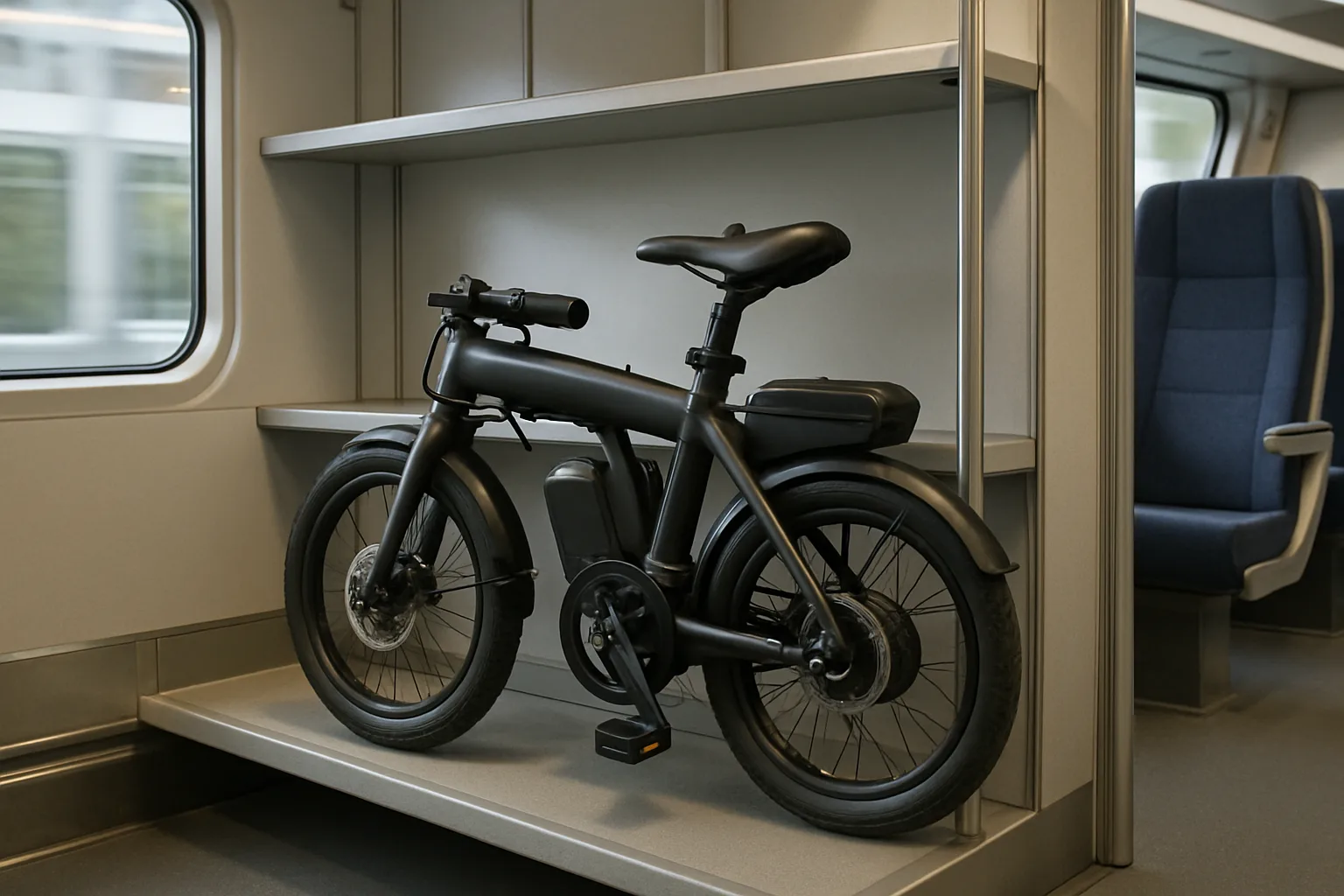
- Stored as luggage: it should sit in a luggage rack, between seats, under a table area if allowed, or another safe luggage space.
- No blocking routes: doors, aisles, wheelchair spaces and emergency areas are non-negotiable.
- Operator policy wins: National Rail guidance is the starting point, but individual train companies can set conditions.
Folding e-bike versus full-size e-bike
A folding e-bike has a much better chance of being allowed without a cycle reservation because it can be treated as luggage. A full-size e-bike is usually treated like a normal full-size bike, which means reservations, peak-time bans, limited cycle spaces and operator-specific restrictions.
This is why the folding part matters more than the electric part for rail travel. The motor adds weight and battery checks, but the fold is what helps you avoid the usual full-size cycle-space problem.
The one-line rule I would use
If your folding e-bike has 16in or 20in wheels, folds in more than one place, and you can lift it into a luggage space, you are in the right territory. If it needs to be wheeled unfolded through the carriage, you are pushing your luck.
What Counts as a Train-Friendly Folding E-Bike?
Train-friendly does not just mean the bike has a hinge. Some folding e-bikes are brilliant for small flats and car boots but still miserable on trains because they are wide, unstable when folded, or too heavy to lift up steps.
Folded size matters more than range
A big battery and long range sound useful, but on trains the folded package is what matters. A compact Brompton Electric C Line folds to about 58.5 x 56.5 x 27cm and weighs roughly 17.6kg-17.9kg with the battery depending on spec. It is expensive, usually around £2,999-£3,109 in UK shops, but the compact fold is the reason commuters still pay Brompton money.
A MiRiDER 16 is another practical UK-built option. The standard MiRiDER 16 is listed at about 17.3kg with folded dimensions around 69 x 46 x 78cm, while the MiRiDER GB3 is around 19.4kg and 77 x 43 x 68cm folded. The GB3 tends to sit around £2,495. Both are more compact than many budget folders, but still heavy enough that stairs at Clapham Junction or Birmingham New Street will focus the mind.
The Tern Vektron Q9 is a different kind of folder: tougher, roomier and more cargo-capable, but around 21.9kg with a folded size of about 42 x 86 x 68.5cm. It is usually north of £3,000 in the UK when available. Lovely bike. Less lovely if you need to lift it above shoulder height into a luggage rack.
Weight is the train test
A bike can be legal and allowed but still a bad train bike. Before buying, stand beside the bike and ask one dull question: can you lift this while also carrying a laptop bag, wearing a coat, and moving quickly because the platform changed?
Use this rough guide:
- Under 16kg: rare for an e-folder, but much easier for frequent train use.
- 16kg-18kg: manageable for many riders if the folded shape is compact.
- 18kg-21kg: fine if you roll more than carry, but stairs and luggage racks become work.
- Over 21kg: only sensible if your stations have lifts, your trains have floor-level luggage space, and you are comfortable handling the weight.
Our folding e-bike buying guide goes deeper on weight, fold size and range. For train use, I would put weight and folded stability above battery range every time.
Wheel size and fold quality
Most train-friendly folders use 16in or 20in wheels. Bigger wheels ride better on potholes, but they make the folded bike longer and harder to stow. A neat 16in fold can tuck beside luggage. A loose 20in fold may need a strap to stop the frame swinging open.
Look for:
- A locked fold: magnets, clips or straps that stop the bike opening while carried.
- Protected chain and oily parts: other passengers should not get chain marks on coats or bags.
- A stable parking position: the folded bike should stand or roll without collapsing.
- Removable battery if designed for it: useful for reducing lift weight, but only if removal is normal for that model.
Operator Rules You Must Check Before Travelling
The biggest mistake is assuming every UK train company uses the same cycle policy. They do not. One operator may treat a folded e-bike as luggage at any time. Another may want it bagged, placed in specific luggage space, or kept away from busy doors.
Check the actual operator, not just the route
Ticket apps often show a route but hide the practical detail. A journey from Reading to Manchester might involve more than one operator. A local branch line may have different space from an intercity train. Engineering works can add rail replacement buses, and buses are much less forgiving with bulky folded bikes.
Before travelling, check:
- Train operator cycle policy: especially folding-bike wording and e-bike wording.
- Peak-time restrictions: usually aimed at full-size bikes, but crowded peak trains can still make folded luggage awkward.
- Reservation rules: folding bikes often do not need one, full-size bikes often do.
- Rail replacement buses: these may refuse bulky bikes if there is no safe luggage space.
National Rail has a cycle-policy index, but I still prefer checking the train company’s own page the day before travel. Policies change, and staff on the ground will follow the operator’s wording.
London and urban networks
Urban networks can be more generous with folded cycles than with full-size bikes, but crowding is the real limit. A folded e-bike at 08:20 on a packed commuter service is a different proposition from the same bike at 11:00.
For London journeys, folded bikes are usually the route around full-size bike restrictions. Folded e-bikes are often treated like folded cycles, but e-scooters are a separate category and are commonly banned. Do not assume a throttle scooter, illegal e-bike or conversion with a questionable battery will be treated like a road-legal folding e-bike.
Intercity trains
Intercity services can be easier if you board early and find luggage space before everyone else arrives. They can also be harder if the luggage racks are already full of suitcases. A compact Brompton-style fold helps here. A large 20in e-folder may fit better in the end-of-carriage luggage area than overhead or between seats.
If you own a bigger folder, book a quieter train where possible. The cost of travelling 40 minutes later is often less painful than standing in a vestibule with a 20kg bike pressed against your shin.
Battery and Safety Rules on Trains
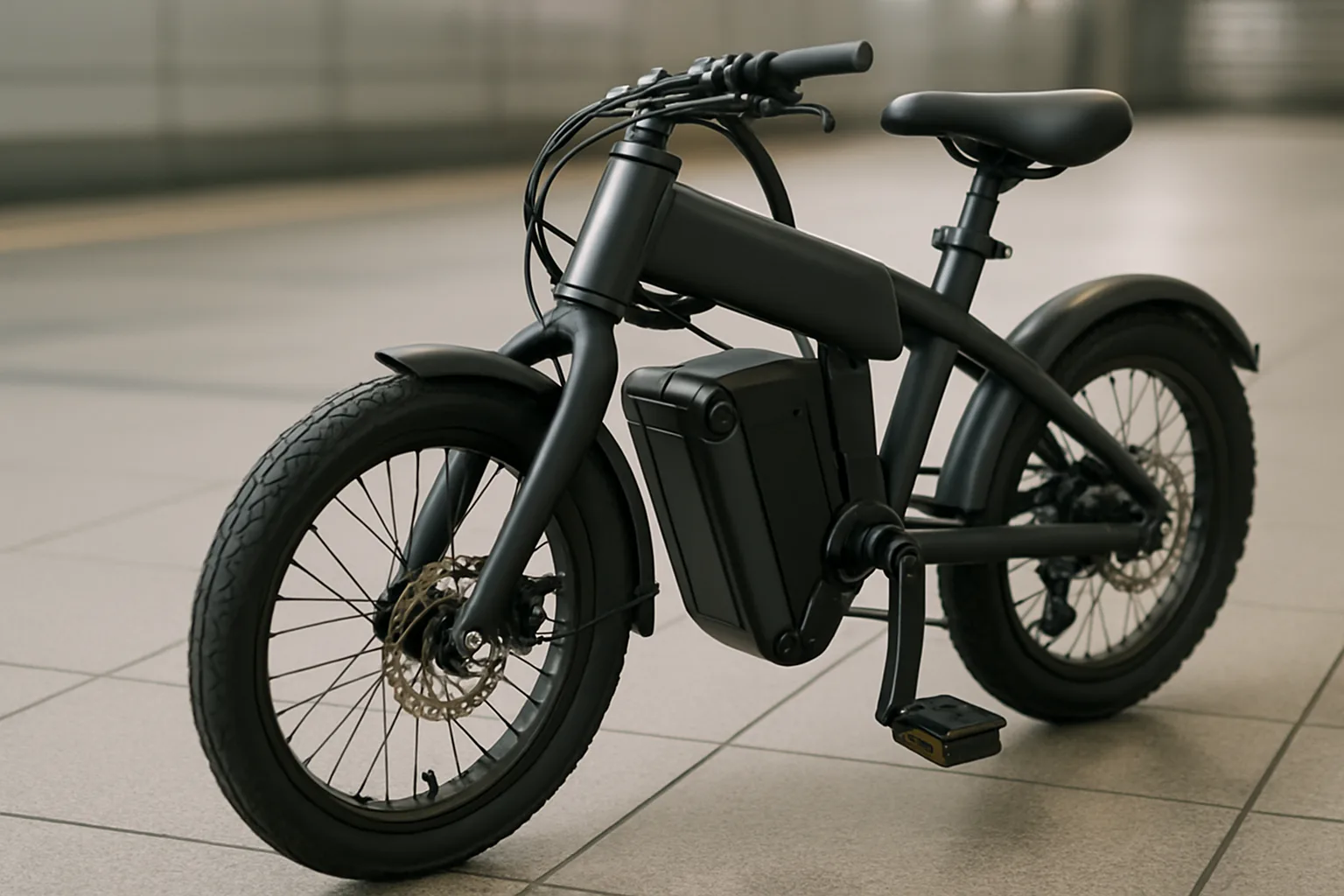
The electric part brings two questions: is the bike road legal, and is the battery safe to carry?
Make sure the e-bike is road legal
For Great Britain, GOV.UK says an electrically assisted pedal cycle must have pedals, a motor with no more than 250W continuous rated power, and assistance that cuts off above 15.5mph. If it meets the EAPC rules, it is treated much like a normal pedal cycle for road use. If it does not, it may be treated as a motor vehicle.
That distinction matters on trains because staff are unlikely to welcome a high-powered throttle bike with a dubious battery and no clear compliance label. If your bike has been modified to go faster, has an aftermarket battery, or can be propelled without pedalling beyond legal limits, do not expect sympathy.
Our UK e-bike law guide covers the legal side in more detail. For train travel, the practical point is simple: a compliant folding e-bike is much easier to explain than a modified one.
Battery condition matters
Do not take a damaged battery onto a train. Swelling, cracked casing, exposed wiring, water damage, burning smell, heat while off, or a charger port that has melted are stop signs. This is not a “see how it goes” situation.
If the battery is removable, secure it as the manufacturer intends. On some folding e-bikes, removing the battery is part of the normal fold or carry routine. On others, leaving it fitted is safer because the mount protects the contacts. Follow the manual rather than improvising.
If you are unsure about battery health, use our battery health checks before a rail trip. A train platform is the wrong place to discover the battery latch is loose.
Charging on trains
Do not plan to charge an e-bike battery on the train. Even if you find a plug socket, that socket is for low-power passenger devices, not for topping up a large lithium e-bike battery. Charge at home, at work, or at a proper destination point.
For most commuting, the better answer is range planning. A 250Wh-350Wh folding e-bike battery is usually enough for short station-to-office legs, but cold weather, hills and high assist can drain it faster than the brochure range. Our watt-hours explainer helps compare batteries without being fooled by optimistic mileage claims.
Boarding, Stowing and Peak-Time Practicalities
Good train travel with a folding e-bike is mostly etiquette and timing. The rules get you through the gate. The handling keeps everyone calm.
Before you reach the platform
Fold the bike before you get to the train door. If your station has wide space near the entrance, use it. A half-folded e-bike on a narrow platform is annoying and easy to knock.
Do this in order:
- Turn the bike off. You do not want walk assist or lights activating while you carry it.
- Remove loose accessories. Take off panniers, dangling locks and phone mounts that catch on seats.
- Fold and latch properly. Check the frame, stem and pedals are locked in their folded position.
- Lift-test before boarding. If the battery is designed to be removed, decide before the train arrives.
- Board away from the busiest door if possible. The quiet carriage end is often easier than the door nearest the ticket barriers.
That list sounds fussy until you have tried folding a wet e-bike while a queue builds behind you. Then it sounds like civilisation.
Where to put it onboard
The best place depends on the train. Luggage racks are ideal if the bike fits and you can lift it without scraping other bags. Between-seat spaces can work on intercity trains. Vestibules are risky because they block movement and attract staff attention.
Avoid:
- Doorways: even for one stop.
- Wheelchair spaces: unless staff explicitly direct you there and you move immediately if needed.
- Aisles: a folded bike is still a trip hazard.
- Seat blocking: buying a ticket does not buy your bike a seat.
If the train is packed, stay pragmatic. Sometimes the best move is waiting for the next service rather than forcing a 20kg folded bike into a carriage that has no luggage room.
Rain, dirt and covers
A dirty folded e-bike is still dirty luggage. In winter, a light folding bike cover or chain cover can prevent awkward moments with other people’s clothes. Full padded bags are bulky, but a simple stretch cover costs about £15-£35 from Amazon UK or Decathlon-style cycling retailers. A Velcro frame strap is often under £10 and stops a loose fold becoming a nuisance.
Keep a small microfibre cloth in the bag. It weighs nothing and saves you from dripping canal-path water across a carriage floor.
What to Buy if Train Travel Matters
This is not a full folding e-bike buying guide. The question here is narrower: what makes a folding e-bike better on trains?
Best overall train-first choice
The Brompton Electric C Line is the train-first answer if budget allows. At roughly £2,999-£3,109, it is not good value in a normal pounds-per-spec sense. You are paying for the fold, the parts ecosystem, the compact footprint and the fact that rail staff recognise what it is. The ride is not as planted as a bigger 20in folder, but the folded package is the point.
Pair it with a small front bag or battery bag rather than giant panniers. Brompton accessories are not cheap; expect about £40-£90 for useful bags and covers depending on size. Still, keeping the battery and daily kit tidy matters more on trains than squeezing out another 10km of range.
Best mid-range practical option
MiRiDER is a strong UK option if you want a sturdier 16in folder and can handle the weight. Expect around £1,595-£2,495 depending on model and spec. The MiRiDER 16 is easier to live with than many budget folders, while the GB3 adds gearing and polish at a higher price.
The trade-off is folded bulk. It is compact, but it is not Brompton compact. For train use, I would try lifting one folded before buying online. A test ride is useful; a test carry is more useful.
Budget route
Halfords and similar retailers often sell electric folding bikes under £1,000, with models such as Carrera or Apollo appearing around £750-£1,000 when discounted. They can make sense for occasional off-peak rail trips and short commutes, but watch the folded latch, weight and battery quality.
Cheap folders often look fine in product photos and feel awkward when folded. Our best folding electric bikes guide is where I would compare the bikes themselves. For trains, I would choose a slightly shorter range and better fold over a bigger battery every time.
Accessories that help
You do not need much. I would buy:
- Frame or wheel strap: £5-£12, stops the fold opening while carried.
- Light folding cover: £15-£35, useful for wet or oily bikes.
- Compact lock: £35-£80, because you may still need to leave the bike briefly at either end. Our e-bike lock guide covers stronger options.
- Battery contact cover if supplied: usually included or under £20 as a spare; useful only if the battery is designed to come off during travel.
Skip heavy panniers for train days. A backpack or small front bag is easier when you need one hand for a rail, one hand for the bike, and no spare hand for wrestling luggage.
Common Mistakes That Get Riders Refused
Most refusals are avoidable. Staff rarely want a debate about folding-bike philosophy; they want a safe train and clear doorways.
Turning up with an unfolded bike
If the bike is meant to travel as luggage, make it luggage before boarding. Rolling it on unfolded and promising to fold it later invites a no.
Buying too much bike
A folding fat-tyre e-bike may fit in a car boot, but that does not make it train-friendly. Big tyres, wide bars, exposed chain lines and 24kg weight are all painful in crowded carriages.
Blocking doors or wheelchair spaces
This is the quickest way to annoy staff and passengers. If you cannot stow the bike safely, get off and wait for a quieter service. Harsh, but better than being told to leave after a row.
Assuming one operator’s rule applies everywhere
Your usual train may be fine. The connection may not be. Check each operator, especially on long journeys, airport routes and rail replacement buses.
Travelling with a questionable battery
Damaged, modified or badly mounted batteries are not worth the risk. If your battery has taken a knock, got wet inside, or started behaving oddly, sort that before taking it onto public transport. The battery replacement guide explains warning signs and UK costs.
Forgetting the return journey
The morning train may be quiet. The evening train may be packed, delayed and full of suitcases. If you barely managed the outward leg, plan a backup: a later train, a different station, or secure cycle parking at one end.
Frequently Asked Questions
Can you take a folding e-bike on a UK train? Usually yes, if it is fully folded, safe to stow as luggage and allowed by the train operator. Always check the operator policy before travel, especially for peak services and rail replacement buses.
Do folding e-bikes need train reservations? Usually not when they are carried as folded luggage, but full-size e-bikes often need cycle spaces or reservations. Some operators add their own requirements, so check the company running your train.
Are e-bike batteries allowed on trains? Road-legal e-bike batteries are usually allowed when fitted securely to the bike, but damaged, modified or unsafe batteries are a serious problem. Do not charge an e-bike battery onboard.
What size folding e-bike is best for train travel? A compact 16in or 20in folder that weighs under about 18kg is easiest. Bigger 20kg-plus folders can work, but they are harder to lift, stow and manage on busy trains.
Can train staff refuse a folding e-bike? Yes. If the folded bike blocks doors, aisles, wheelchair spaces or safe movement, staff can tell you to move it or refuse carriage. Operator policy and safety come before convenience.
Is a Brompton Electric worth it for train commuting? If train travel is central to your commute and the budget works, yes. It costs around £2,999-£3,109, but the compact fold is better for trains than many cheaper, bulkier folding e-bikes.