The safest overnight place for a removable e-bike battery is indoors, cool, dry, away from escape routes, and away from anything that would burn quickly. In a typical UK home, that usually means a utility room, kitchen corner or garage shelf on a hard surface, not a hallway, bedroom, sofa, under-stairs cupboard or damp shed floor.
In This Article
- Best Overnight Storage Spot for Most UK Homes
- Quick Storage Decision Table
- Flat Storage: Hallways, Kitchens and Cupboards
- Shed and Garage Storage: What Changes
- What to Buy for a Safer Storage Setup
- Warning Signs Before You Store a Battery Overnight
- Simple Overnight Routine
- Frequently Asked Questions
Best Overnight Storage Spot for Most UK Homes
For most people, the best answer is boring: remove the battery from the bike, let it cool after the ride, then store it on a clear, hard surface in a room you are not sleeping in. A metal utility shelf, kitchen worktop corner or garage shelf is much better than soft furnishings, cardboard boxes or a crowded hallway.
The key phrase is not just “indoors”. It is “indoors without blocking your way out”. London Fire Brigade’s e-bike and e-scooter safety advice is clear on keeping escape routes free and using the correct charger. That matters in flats, where one hallway often does everything: coats, shoes, buggy, bike, charger and front door. Add a battery there overnight and you have made the worst part of the home busier.
I would rather store a healthy removable battery in a cool kitchen corner than in a damp shed. I would rather store it in a detached garage than in a bedroom. I would not store it under stairs if that cupboard is also full of coats, wrapping paper, paint, camping kit and spare cardboard. That is not because every battery is waiting to fail. It is because if something does go wrong, the surroundings decide whether it stays contained or becomes a serious problem.
This article is about storage location, not general charging technique. For plug choice, charger placement and daytime charging habits, use our how to charge an e-bike at home guide alongside this one.
What if the battery is not removable?
Some lightweight road e-bikes and cheaper hub-motor bikes have batteries that are awkward or impossible to remove for normal charging. In that case, the storage decision becomes a bike decision rather than a battery decision. Put the whole bike somewhere dry, away from the exit route, and away from soft furnishings. A hallway is still the weak option if it narrows the only way out.
If you have to store the whole bike indoors, a kitchen/utility wall space or spare-room hard floor is usually better than a bedroom corner. A basic wall wheel hook or floor stand costs about £10-£35, but check the bike’s weight first; many e-bikes are 18-25kg and cheap hooks can flex. In a garage, a floor stand is often safer than hanging a heavy e-bike above tools or boxes.
For non-removable batteries, be stricter about charger access. You want a socket close enough that the cable is not stretched, crushed under a door, or lying where someone will trip over it. If that means charging for two hours after dinner rather than overnight, that is a better habit.
Quick Storage Decision Table
| Location | Overnight verdict | Why | Typical setup cost |
|---|---|---|---|
| Kitchen or utility room hard surface | Best for most flats and houses | Dry, visible, usually away from bedrooms, easy to keep clear | £0-£40 for a tray or small metal shelf |
| Garage metal shelf | Good if dry and not freezing | Hard surfaces and space, but watch cold and damp | £25-£80 for shelving, £10-£20 for a plug-in RCD if needed |
| Shed | Only if dry, secure and above freezing | Damp, theft and winter cold are the usual problems | £30-£100 for shelf, weather sealing and a lock upgrade |
| Hallway or by front door | Avoid overnight | Can block the escape route if there is smoke, heat or clutter | Free, but poor risk trade-off |
| Bedroom or beside the sofa | Avoid | Too close to sleeping/living space and soft furnishings | Free, but not worth it |
The table is deliberately practical rather than alarmist. A quality Bosch, Shimano, Mahle or Specialized battery used with the correct charger is not the same as a damaged bargain battery with an unknown charger. Still, storage location is one of the few safety decisions you control every single night.
Flat Storage: Hallways, Kitchens and Cupboards
Keep the escape route boringly clear
In a flat, the front door route matters more than almost anything else. Do not store the battery, charger or whole bike in a narrow hallway overnight if it makes the exit harder to use. This is especially true if you have children’s shoes, a buggy, coats or recycling already narrowing the space.
A better flat setup is a small hard-surface station away from the main exit line: a kitchen counter end, a metal utility trolley, or a clear shelf in a ventilated utility cupboard. A simple three-tier metal trolley costs about £25-£45 from IKEA, Argos or Amazon UK. A fire-resistant mat or ceramic tile under the charger is usually £8-£20. You do not need to turn the room into a laboratory; you just need to stop balancing a lithium battery on a pile of coats.
Avoid the bedroom shortcut
Bedrooms are tempting because they feel secure. If you live in a flat and worry about theft, bringing the battery into the bedroom can feel sensible. I would still avoid it overnight. You are asleep, the room has soft furnishings, and a problem would be closer to you than it needs to be.
If theft is the driver, remove the battery from the bike and store it in the kitchen or utility area instead. For the bike itself, use a good lock even indoors if the communal area is shared. Our best e-bike locks UK guide covers lock budgets, but expect £60-£120 for something worth using on an expensive e-bike.
Under-stairs cupboards need a hard look
Under-stairs storage is fine for hoovers and shoes. It is often poor for e-bike batteries because it becomes a clutter cave. If yours contains coats, paper, paint, camping gas, cleaning bottles or cardboard, do not add a battery and charger overnight.
If the cupboard is dry, ventilated, uncluttered and not part of your escape route, it can work. Use a metal shelf, keep the charger off the carpet, and leave space around the battery. A basic wall-mounted metal shelf is about £15-£35 from Screwfix, B&Q or Amazon UK.
Shed and Garage Storage: What Changes
Garages can be good, sheds are conditional
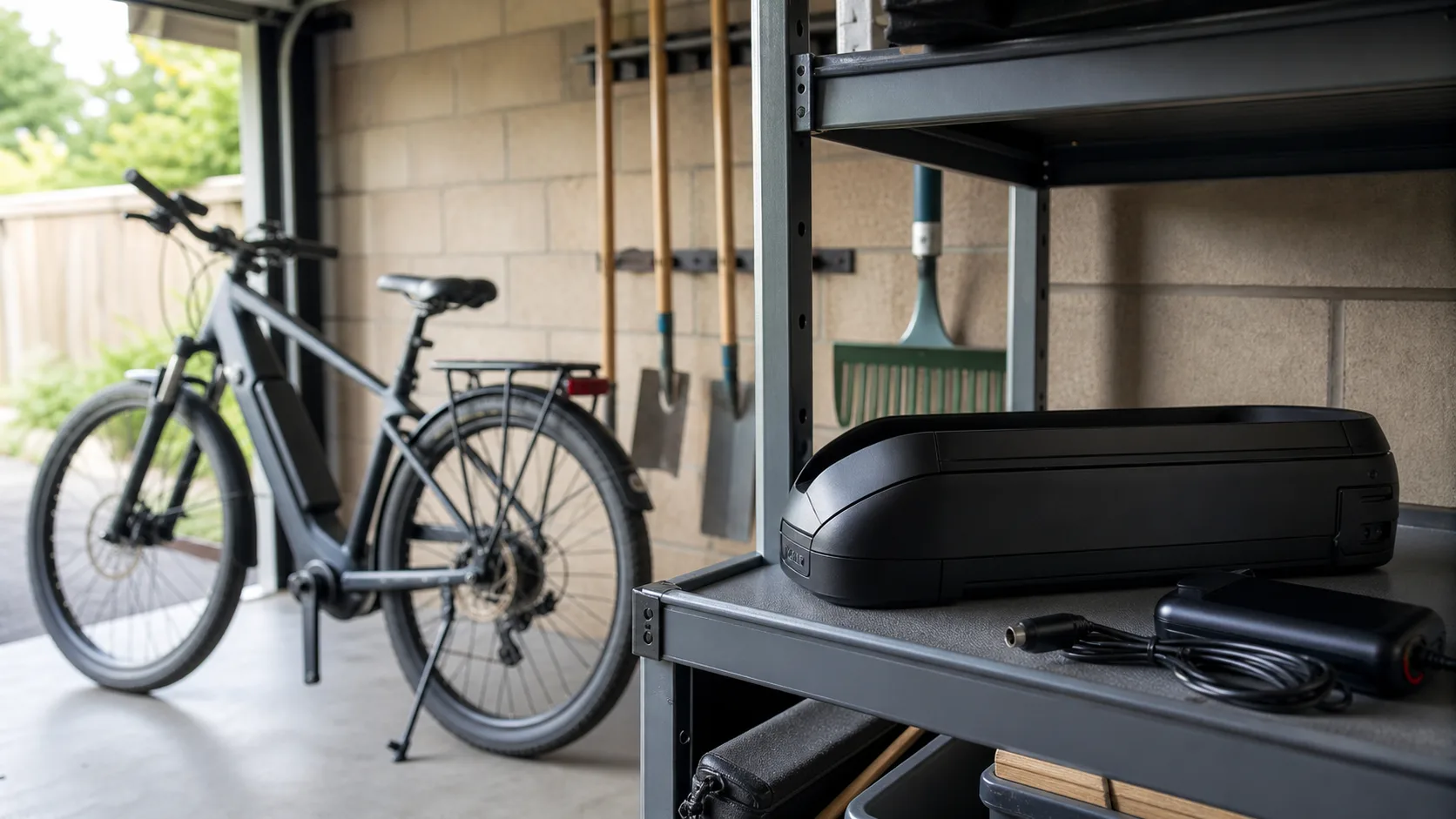
A dry garage with a concrete floor and metal shelving is one of the better overnight storage options. It keeps the battery away from living space, gives you hard surfaces, and usually has more room to avoid clutter. The weak points are cold, damp, extension leads and piles of combustibles.
Sheds are more awkward. They are often damp, colder overnight, less secure and full of exactly the things you do not want around a battery: cardboard, petrol garden tools, paint, solvents, old cushions and dry timber. If your shed smells damp or gets condensation on tools, store the battery indoors instead.
Cold is a performance and charging issue
Storage in a cold garage is not automatically dangerous, but charging a very cold battery is a bad habit. If the battery has been sitting near 0°C overnight, let it come back towards room temperature before charging. This is covered in our broader e-bike battery guide, but the short version is simple: cold storage reduces range, and cold charging can stress cells.
For winter, store around 40-70% charge if the bike will sit unused for days. Do not leave it flat in a shed for a month. Do not leave it permanently full either. If you ride daily, a dry garage shelf is fine; if the bike is parked for winter, bring the battery into a cool indoor room and check it monthly.
Extension leads are usually the messy bit
The battery location is only half the setup. The plug arrangement matters too. Avoid daisy-chained extension leads and cheap multi-gangs buried behind storage boxes. If the garage socket is in the wrong place, move the storage shelf closer to the socket rather than stretching cable across the floor.
A plug-in RCD adapter costs roughly £10-£20 from Screwfix, Toolstation or B&Q. It is not a magic battery-fire shield, but it is a sensible extra layer if you are charging in a garage with older electrics. If sockets are damaged, warm, loose or frequently tripping, get an electrician in rather than working around it with another adapter. A small domestic electrician visit commonly starts around £80-£150 depending on location and call-out terms.
If the garage has no proper socket, do not run a thin indoor extension lead under the door overnight. Either charge the battery indoors in a better spot or budget for a proper outdoor/garage-rated socket installation. It is dull advice, but dull electrical work is exactly what you want here.
What to Buy for a Safer Storage Setup
You do not need a shopping spree. The best setup is usually cheap because it is mostly about location, surfaces and habits.
- Metal shelf or trolley: £25-£80. Useful for garages, utility rooms and flats where the battery otherwise ends up on the floor.
- Ceramic tile, metal tray or heat-resistant mat: £8-£25. Gives the charger and battery a hard, non-fabric surface.
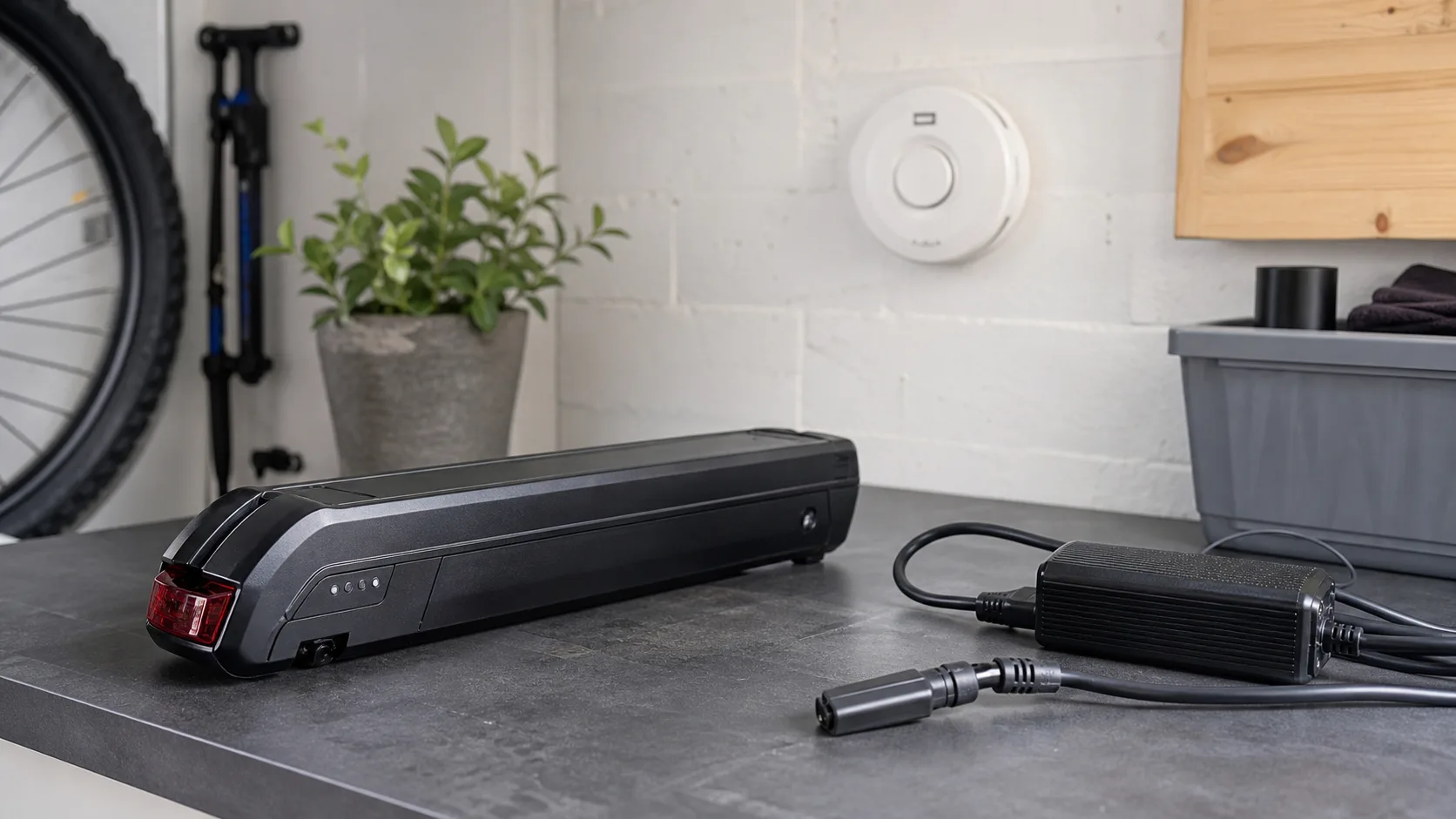
- Smoke alarm or heat alarm: £8-£30 depending on type. For garages, a heat alarm is often less nuisance-prone than a smoke alarm.
- Plug-in RCD adapter: £10-£20. Sensible in garages or older outbuildings when used with proper sockets.
- Original replacement charger: usually £40-£120 depending on brand. Do not use a cheap unknown charger to save £25.
- Battery storage bag: about £25-£70. Useful for transport or a little extra containment, but not a licence to store the battery in a bad place.
Battery bags are the most misunderstood item in that list. A decent bag can reduce heat spread and make transport neater, but it does not fix a damaged battery, a wrong charger or a blocked hallway. If you want one, read our best e-bike battery bags guide and still choose the right location first.
Electrical Safety First’s e-bike usage and safety advice is worth reading before buying chargers or replacement batteries. The big point is the unglamorous one: use manufacturer-approved chargers and avoid modified or incompatible kit.
Warning Signs Before You Store a Battery Overnight
Most overnight storage advice assumes a healthy battery. If the battery is damaged, swollen, smells odd or behaves strangely, do not treat it like a normal battery and do not bring it into a bedroom or cupboard “just for tonight”.
Watch for:
- Swelling or casing distortion: any bulging, cracking or seams opening.
- Heat after use or charging: warm is normal; hot or heating while unplugged is not.
- Chemical smell: sweet, solvent-like or metallic smells are a stop sign.
- Visible damage: dents after a crash, crushed casing, exposed contacts or water ingress.
- Charging behaviour changes: sudden cut-outs, charger errors, or capacity dropping fast.
If you see those signs, move the battery away from people and combustible materials if safe to do so, stop charging it, and speak to the bike brand, dealer or a qualified battery specialist. Our damaged e-bike battery disposal guide covers what to do next. Do not put a lithium battery in household waste.
Replacement cost is painful but sometimes the right answer. A Bosch, Shimano or major-brand replacement battery is often £350-£700. A diagnostic or inspection at a bike shop may be £30-£80. That is still cheaper than gambling on a battery that has already warned you.
Simple Overnight Routine
The safest routine is the one you will actually do after a wet ride home.
- Let the battery cool for 20-30 minutes if the ride was hard or the weather was hot.
- Wipe rain and grit off the casing and contacts with a dry cloth.
- Put the battery on a clear hard surface, away from coats, paper, curtains and cardboard.
- Keep it away from the main escape route, especially in flats.
- Charge in the evening while you are awake if it needs charging, then unplug before bed.
- Leave it around 40-70% if you are not riding the next day.
That last point is good for safety and lifespan. You do not need a full battery every morning if your commute uses 20%. The habit of charging to 100% overnight, every night, is convenient but not ideal for long-term battery health. If range is starting to fall quickly, our when to replace an e-bike battery guide explains the difference between normal ageing and a battery that needs attention.
For most homes, the answer becomes simple: store the battery where a sensible person would put a hot laptop charger, then be stricter because the battery is bigger and more expensive. Hard surface. Dry room. Clear space. Correct charger. Unblocked exit. That gets you most of the way there.
Frequently Asked Questions
Where should I store an e-bike battery overnight? Store it on a clear hard surface in a cool, dry place away from escape routes and combustible clutter. A utility room, kitchen corner or dry garage shelf is usually better than a hallway, bedroom or damp shed.
Can I store an e-bike battery in a shed overnight? Only if the shed is dry, secure and not close to freezing. Damp, condensation, theft risk and clutter make many UK sheds poor overnight battery storage spaces.
Is it safe to charge an e-bike battery overnight? It is better to charge while you are awake and unplug before bed. Use the correct manufacturer-approved charger, avoid extension-lead clutter and keep the battery on a hard surface.
Should I keep an e-bike battery in the house or garage? A dry garage with a metal shelf can be excellent. In a flat or terraced house, a kitchen or utility-area hard surface is often better than a hallway or bedroom.
Do I need a fireproof e-bike battery bag? Not always. A battery bag can add a layer of containment for storage or transport, but it does not replace a safe location, correct charger or healthy battery.
What should I do if my e-bike battery looks swollen or smells odd? Stop using and charging it, keep it away from people and combustible materials if safe, and contact the bike brand, dealer or a qualified battery specialist. Do not put it in household waste.