Fitting a child seat to an e-bike is not just a normal bike-seat job with a battery added; the extra weight, rack design and motor assistance make the compatibility checks more important than the bracket itself.
In This Article
- Should You Fit a Child Seat to Your E-Bike?
- Check Your E-Bike Compatibility First
- Choose the Right Child Seat Type
- Tools, Parts and Pre-Fit Checks
- How to Fit a Rear Child Seat
- Test the Bike Before Carrying Your Child
- Common E-Bike Child Seat Mistakes
- When a Trailer or Cargo E-Bike Is Better
- Frequently Asked Questions
Should You Fit a Child Seat to Your E-Bike?
You can fit a child seat to some e-bikes, but not every e-bike should take one. The safe answer depends on the bike’s frame, rack rating, battery position, brake quality, total load limit and the child’s weight.
If you want to fit a child seat to an e-bike safely, start with the boring checks. They are not optional. A rear child seat puts a high, moving load above the back wheel, and an e-bike is already heavier than a normal hybrid. That combination can feel fine in the garage and horrible at the first slow junction.
When it makes sense
A child seat can work well if:
- Your e-bike has a strong rear frame or rated rack: ideally with a clear maximum load stamped on it.
- Your child is within the seat limit: many rear seats are rated around 9-22kg, but always check the exact model.
- You ride short, predictable routes: nursery runs, park paths and quiet local errands are the natural use case.
- You can still handle the bike slowly: the first test is walking and turning the loaded bike, not pedalling it.
The setup is less convincing if your bike has a tiny folding frame, an integrated rear battery, a decorative rack, weak mechanical brakes or a very high step-over that makes mounting awkward.
E-bike law still matters
Adding a child seat does not change UK e-bike rules. A road-legal EAPC must meet the normal GOV.UK electric bike rules, including pedal assistance rather than throttle-only riding, a maximum continuous rated motor output of 250W and assistance cutting off at 15.5mph.
That legal limit is not a target speed with a child on the back. With a passenger, I would rather arrive two minutes later than discover how top-heavy the bike feels under braking.
Check Your E-Bike Compatibility First
Do this before buying a seat. It saves money, and it prevents the classic mistake of trying to force a good child seat onto the wrong bike.
Check the total weight limit
Find the bike’s maximum system weight. That usually means rider, child, bike, luggage, seat and accessories combined. It may be printed in the manual or on the manufacturer’s website. If your e-bike is rated to 120kg total and the bike itself weighs 25kg, a 78kg rider, 4kg child seat, 18kg child and 5kg bag already use 130kg. That is over the limit before you have added a lock.
Our e-bike weight limits guide covers this properly, but the short version is simple: do not treat the rack limit and bike limit as separate permission slips. You need to satisfy both.
Check the rack
A rack-mounted child seat needs a rack rated for child-seat use, not just a rack that can carry panniers. Many standard racks are rated to 15-25kg, but some are not approved for child seats because the load sits higher and moves differently.
If your e-bike came with a rear rack, look for a stamped rating. If the rack says 25kg but the child seat requires 27kg or a specific standard, do not fudge it. A replacement e-bike rack is usually £35-£80 from Halfords, Decathlon, Tredz or Amazon UK, but compatibility with the frame and rear axle matters.
Check battery and frame clearance
Frame-mounted child seats often clamp around the seat tube. On many e-bikes, that area is blocked by a battery, a chunky weld, a rear suspension linkage or cabling. Step-through frames can be awkward too because the tube shapes are not always round or accessible.
Rack-mounted seats avoid some frame-clamp problems, but they bring their own checks: heel clearance, saddle clearance, wheel clearance, rack width and whether the battery slides out under the rack.
Choose the Right Child Seat Type
Most e-bike owners should start by looking at rear seats. Front seats can be useful on normal bikes for small children, but e-bike cockpits are often crowded with displays, cables, lights and wider handlebars.
Rear rack-mounted seats
Rack-mounted seats clamp or click onto a compatible rear rack. They suit e-bikes with strong racks and clear rear-wheel space. The good ones are quick to remove, which matters if the bike also does shopping or commuting duty.
Typical UK prices:
- Budget: Polisport and Decathlon-style rear seats are usually about £45-£80.
- Mid-range: Hamax Siesta or basic Thule rear seats often sit around £85-£130.
- Premium: Thule Yepp 2 Maxi, Thule Yepp Nexxt and Hamax Caress models are commonly about £120-£170 depending on mount and colour.
The premium seats are not magic, but they usually have better buckles, foot straps and adjustment. That matters when you are trying to clip in a wriggly child while the bike is balanced on a stand.
Rear frame-mounted seats
Frame-mounted seats use a bracket on the seat tube and suspend the seat behind the saddle. They can ride nicely on a normal hybrid, but e-bike frame shapes often get in the way. Before buying, check the seat maker’s compatibility diagram rather than assuming a round tube exists where you need it.
Thule’s own child bike seat guide is useful here because it explains the difference between frame-mounted, rack-mounted and front-mounted seats, plus typical child weight limits.
Front seats
Front-mounted seats are rarely my first choice on an e-bike. They put weight near the steering, compete with displays and can make mounting the bike clumsy. Some parents like the visibility and conversation, but if your route includes traffic, kerbs or tight school-gate manoeuvres, rear mounting is usually calmer.
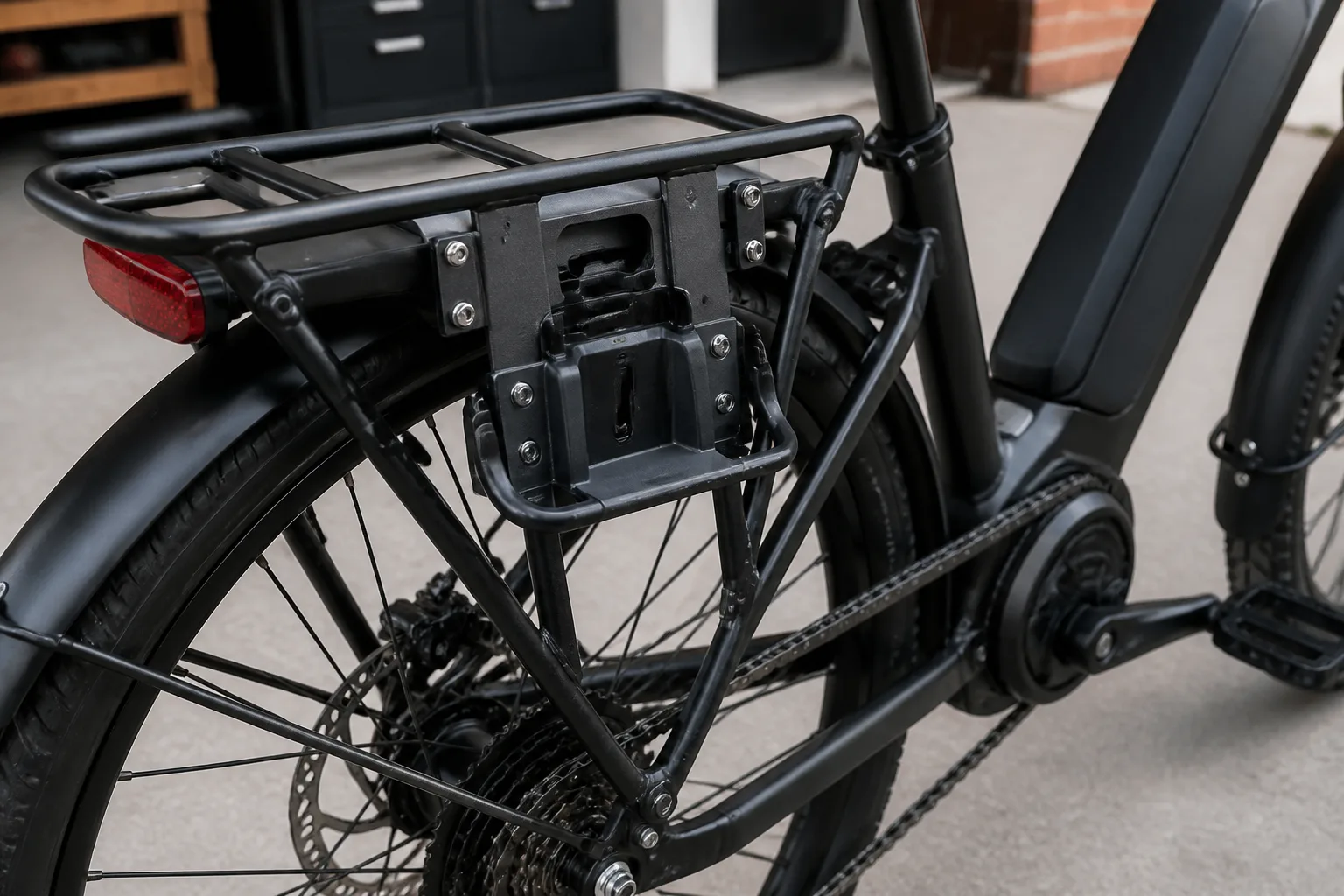
Tools, Parts and Pre-Fit Checks
You do not need a workshop full of tools, but you do need the right basics. A child seat is not the place for “tight enough by feel” if the manual gives a torque setting.
What to have ready
Before fitting, gather:
- Seat manual: the exact model manual, not a similar one from Google images.
- Allen keys: a decent set costs about £8-£15.
- Torque wrench: useful if the mount gives Newton metre settings; expect £25-£60.
- Threaded bolts and adapters: use the supplied hardware unless the manual says otherwise.
- Tyre pump: heavier loads need tyres inflated correctly before testing.
- Helmet: a child helmet is usually £20-£45 from Halfords, Decathlon or local bike shops.
If you do not already own a torque wrench, this is a sensible excuse to buy one. The cheap beam-style ones are not glamorous, but they are better than guessing.
Check the bike before adding the seat
Make sure the bike is already in good order. Brakes should bite cleanly, tyres should not be cracked, wheels should spin true and the kickstand should not be carrying the bike’s entire personality. If your e-bike already needs a service, do that first.
For carrying kit and load around the rear of the bike, our e-bike rear racks guide is a useful cross-check. A rack that is fine for panniers is not automatically fine for a child seat.
How to Fit a Rear Child Seat
The exact process depends on the model, so the manual wins. Still, most rear child seats follow the same pattern.
The fitting sequence
- Stabilise the bike. Work on level ground. If the bike has a weak kickstand, lean it against a wall or use a repair stand.
- Remove panniers and loose accessories. Clear the rack, saddle bag, rear light straps and anything that could sit under the bracket.
- Position the mount. Place the rack clamp or frame bracket exactly where the manual shows, checking battery and wheel clearance.
- Tighten evenly. Alternate bolts gradually rather than cranking one side down first.
- Fit the seat body. Click or bolt the seat into the mount, then pull up and back to confirm it is fully locked.
- Set footrests and straps. Feet must not reach spokes, mudguards, brake rotors or the tyre.
- Check saddle clearance. The rider must be able to pedal and shift weight without hitting the seat shell.
- Recheck all bolts. Go back over every fastener after the seat is fitted, because the first tightening can settle the bracket.
Do not modify the rack, drill holes or replace supplied bolts with random garage leftovers. If the parts do not fit, the seat is wrong for the bike.
Heel strike and leg clearance
Heel strike is more common than people expect. With the seat fitted, pedal backwards slowly and see if your heel hits the footrest, child seat shell or straps. If it does, adjust before riding. If you cannot remove the strike, the setup is not suitable.
This is where step-through e-bikes can be lovely. Getting on and off without swinging a leg over the child seat is much easier, especially when the bike is loaded.

Test the Bike Before Carrying Your Child
The first test ride should be boring. No child, no shopping, no traffic, no steep hill. Just the bike with the empty seat fitted.
Start without assistance
Push the bike first. Turn it tightly, lean it slightly, stop it and put it on the stand. Then ride in a quiet space with the motor off or in the lowest assist setting. You are checking balance, braking and steering before adding the most precious load you will ever carry.
Once that feels normal, add a weighted bag in the seat area if the manual allows and repeat the test. Do not strap random heavy objects into the child harness, but a controlled load in a pannier can help you feel the rear weight before the first real ride.
First ride with your child
Keep the first ride short. Five to ten minutes around quiet roads or a traffic-free path is enough. Use the lowest useful assistance level, brake earlier than normal and avoid standing starts on steep slopes.
If you ride in traffic, revisit our e-bike traffic safety tips before making this your weekday routine. A child seat changes your stopping distance and your confidence gap at junctions.
Battery range changes
A child seat, child, extra helmet, lock and changing bag can add 20-30kg. Your range will drop, especially on hills. If your normal route already uses most of the battery, read our watt-hours guide and plan more conservatively.
For short nursery runs, this is rarely a problem. For longer family rides, it matters. Running out of battery with a loaded e-bike is not dangerous by itself, but pushing a heavy bike home with a tired child is nobody’s idea of character building.
Common E-Bike Child Seat Mistakes
Most failed setups are not caused by bad seats. They are caused by assuming compatibility from a product photo.
Using an unrated rack
This is the big one. A rack that carries two panniers is not automatically approved for a child seat. The seat creates leverage and movement that groceries do not. If the rack has no rating and the bike maker will not confirm suitability, do not use it.
Blocking battery removal
Some rear seats sit exactly where the battery needs to slide out. That means you either remove the seat every charge or start leaving the battery on the bike outside. Neither is ideal. Check battery removal before tightening the final bolts.
Ignoring brake condition
An e-bike with a child seat needs dependable brakes. Hydraulic discs are ideal, but good mechanical discs can work if they are adjusted properly. Worn pads, rubbing rotors or spongy levers need fixing before the seat goes on.
If the bike already has brake noise or poor bite, fix that first. Our disc brake adjustment guide covers the common squeal and alignment issues.
Overloading the rear
A child seat plus heavy panniers on the same rear rack is asking a lot from the bike. Put shopping in a front basket only if the bike handles it well, or use a trailer/cargo setup instead. The goal is a calm bike, not a mobile storage unit.
When a Trailer or Cargo E-Bike Is Better
A child seat is brilliant for short, simple trips with a child inside the seat limit. It is not the best answer for every family.
Choose a trailer if stability matters more than filtering
A decent child trailer costs about £250-£700. It is wider, slower and more awkward to store, but it keeps the child lower and separate from the bike’s balance. For parks, towpaths and longer weekend rides, that can be better than a high rear seat.
Choose a cargo e-bike for daily transport
If you are doing nursery runs every day, carrying two children or adding school bags and shopping, a cargo e-bike starts to make sense. A longtail family e-bike is usually £2,800-£5,500 in the UK, which is a lot of money, but it is built for the load rather than adapted afterwards.
We have a separate guide to safely carrying children on a cargo e-bike, and that is the better route if your current bike fails the rack or weight checks.
My practical recommendation
For one small child and short rides, I would use a quality rear rack-mounted seat on a suitable step-through or hybrid e-bike. For a heavier child, a second child, hilly routes or daily utility riding, I would skip the adapted seat and look at a trailer or cargo bike.
That is not upselling. It is the difference between a bike that tolerates the job and a bike designed for it.
Bottom Line
To fit a child seat to an e-bike safely, confirm the bike’s total system weight, rack or frame compatibility, child weight limit, battery clearance and brake condition before buying anything. A £120-£160 premium rear seat is wasted money if the rack underneath is not approved for child-seat loads.
The setup I would trust is a road-legal e-bike, a rated rear rack, a known seat brand such as Thule, Hamax or Polisport, carefully torqued fittings, a short empty test ride and a cautious first ride with the child. If any of those steps feel like a stretch, a trailer or cargo e-bike is the better answer.
Frequently Asked Questions
Can you fit a child seat to any e-bike? No. The e-bike needs suitable frame or rack compatibility, enough total weight capacity, clear battery access and brakes strong enough for the extra load.
Is a rack-mounted or frame-mounted child seat better for an e-bike? Rack-mounted seats are often easier on e-bikes because batteries and frame shapes can block frame-mounted brackets. The rack must still be rated for child-seat use.
How much does an e-bike child seat setup cost? Expect about £45-£170 for the child seat, £35-£80 for a suitable rack if needed, and £25-£60 for a torque wrench if you do not already own one.
What child weight limit do rear bike seats usually have? Many rear child seats are rated around 9-22kg, but limits vary by model and mount. Always use the lower limit if the seat and rack differ.
Will a child seat reduce e-bike range? Yes. A child, seat and extra kit can add 20-30kg, so range drops most on hills, stop-start routes and colder days.
When is a trailer better than a child seat? A trailer is better if your e-bike fails compatibility checks, your child is near the seat limit, or you want lower, more stable carrying for longer traffic-free rides.